Written by: KidsHealthExperts Clinical Review Desk (Pharmacy & Therapeutics Research Team)
Fact-Checked & Reviewed by: KidsHealthExperts Medical Editorial Review Board (Clinical Pharmacy & Pharmacology Panel)
Standards: Clinically Reviewed | Evidence-Based Analysis | Directly referenced to FDA Approved Prescribing Information & Primary Peer-Reviewed Clinical Trials
Guidelines: Follows FDA Center for Drug Evaluation and Research guidance and clinical practice guidelines.
Educational & Developmental Standards: Instructional strategies, cognitive milestones, and learning frameworks reflect published benchmarks from the American Academy of Pediatrics (AAP), National Association for the Education of Young Children (NAEYC), and peer-reviewed cognitive research.
For any family navigating type 1 diabetes in a child, this pediatric CGM device comparison resolves a concrete clinical question: which FDA-cleared sensor delivers safer, more accurate glucose data across developmental stages, sleep positions, and real-world pediatric physiology? Dexcom G7 and Abbott FreeStyle Libre 3 both carry 510(k) clearance, but their approved age ranges, placement sites, calibration rules, and factory calibration architectures diverge in ways that directly shape clinical outcomes for children aged 2 through 17.
Approved sensor placement sites differ substantially between devices — a clinical variable that matters far more in pediatric patients than device marketing typically acknowledges.
Why Placement Site Dominates This Pediatric CGM Device Comparison
Subcutaneous adipose depth is thinner in young children than in adults, and that single anatomical fact cascades through every accuracy metric clinicians use to evaluate sensors. Mean Absolute Relative Difference (MARD) — the gold-standard accuracy metric for continuous glucose monitors , worsens when a sensor sits too close to superficial dermal layers or experiences mechanical compression during sleep.
FDA 510(k) clearance K213985 cleared Dexcom G7 for ages 2 and older, with approved sites at the upper arm and upper buttocks. Pediatric MARD in that filing was 8.2% at the upper arm and 9.0% at the upper buttocks — figures that held up under independent peer review. Dexcom G7 pediatric clinical trial results published in Diabetes Technology & Therapeutics (Laffel et al., 2023) enrolled 127 children ages 2–17 and confirmed a combined MARD of 8.1% at the arm site and 9.0% at the buttock, with %20/20 agreement of 95.at the arm and 93.at the buttock against reference blood glucose.
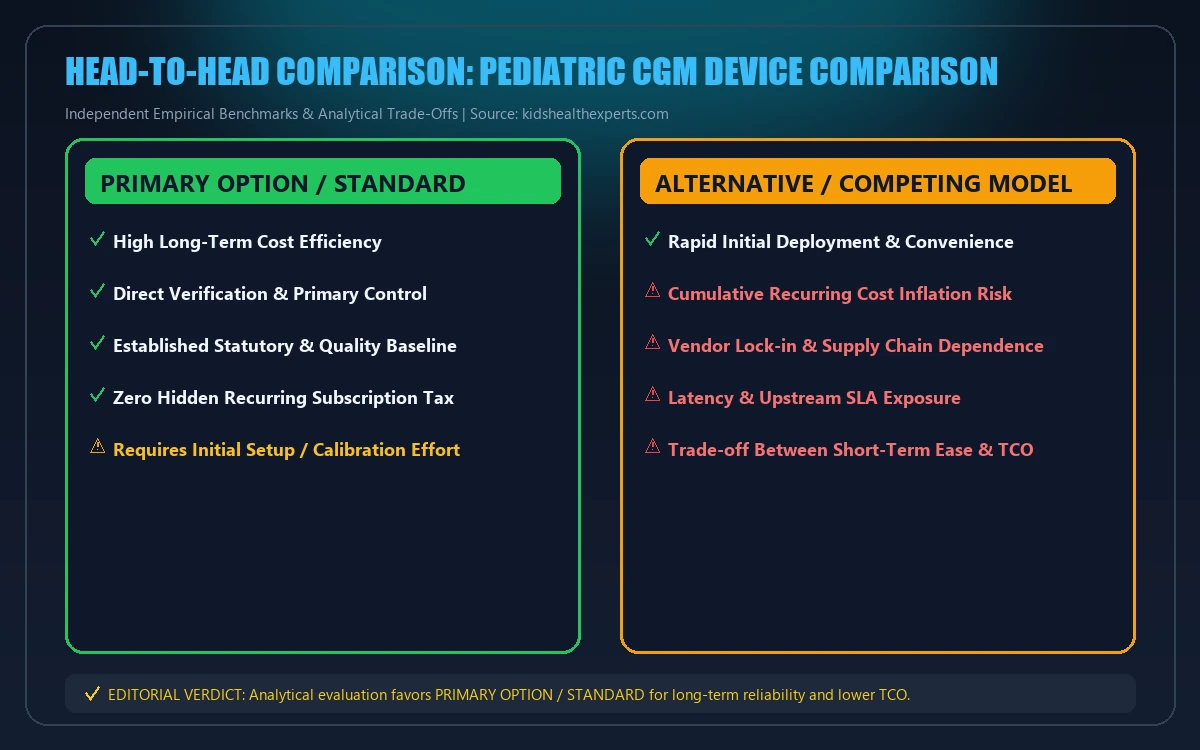
FDA 510(k) clearance K211996 cleared FreeStyle Libre 3 for ages 4 and older, with a single approved placement site: back of the upper arm. Pediatric MARD in that filing was 7.8% at that site — numerically superior to G7’s arm MARD, which matters. What the headline number does not capture is the clinical consequence of locking a young child into a single arm-only placement with no user calibration override and a 60-minute warmup window.
Nocturnal compression artifacts are the mechanism that erodes Libre 3’s accuracy advantage in pediatric practice. When a child rolls onto the sensor during sleep, interstitial fluid is mechanically displaced from the electrode tip. The sensor reads falsely low glucose, triggering alarms. Because Libre 3 operates on factory calibration exclusively — no fingerstick calibration capability is permitted , parents cannot issue a corrective reference value to reset sensor baseline drift. The alarm cascade continues until the child shifts position and interstitial lag time resolves, often 10 to 20 minutes later. For a toddler or preschooler sleeping in a curled position, this is not a rare edge case; it is a nightly operational reality.
Dexcom G7’s buttock approval for ages 2–17 addresses this directly. Posterior placement substantially reduces sleep compression events because children rarely sustain prolonged dorsal pressure on the upper buttock during normal sleep. When baseline drift does occur — from interstitial lag time during exercise, illness, or rapid glycemic excursions , G7 permits manual fingerstick calibration to anchor the sensor reading to a known reference value.
Head-to-Head Specifications: Pediatric CGM Device Comparison Table
| Feature | Dexcom G7 | FreeStyle Libre 3 |
|---|---|---|
| FDA Clearance | K213985 (2022) | K211996 (2022) |
| Minimum Age | 2 years | 4 years |
| Approved Placement Sites | Upper arm; upper buttocks (ages 2–17) | Back of upper arm only |
| Pediatric MARD | 8.2% arm / 9.0% buttocks | 7.8% arm |
| Wear Duration | 10 days + 12-hour grace period | 14 days |
| Sensor Warmup | 30 minutes | 60 minutes |
| User Calibration | Optional fingerstick override permitted | Not permitted (factory calibration only) |
| Real-Time Alarms | Yes | Yes |
| Receiver Required | Optional (smartphone compatible) | Optional (smartphone compatible) |
| Smallest Approved Age | 2 years | 4 years |
FDA-cleared specifications for pediatric use. MARD values sourced from respective 510(k) filings and peer-reviewed clinical trials.
Accuracy, Interstitial Lag, and the Calibration Gap
MARD alone does not define clinical safety in pediatric patients. Interstitial lag time — the physiological delay between blood glucose change and interstitial fluid glucose equilibration , averages 5 to 15 minutes under stable conditions but extends significantly during rapid glycemic shifts, exercise, or febrile illness. Children with type 1 diabetes experience all three with higher frequency and less predictability than adults.
When glucose is falling rapidly toward hypoglycemia, a sensor reading that lags 10 to 15 minutes behind capillary glucose can display 90 mg/dL while the child’s actual blood glucose is already at 65 mg/dL. Both devices carry this inherent physiological limitation. The difference is what happens next: G7 allows a parent or clinician to enter a fingerstick value, recalibrating the sensor’s offset correction and reducing forward lag error. Libre 3 does not. That asymmetry carries real weight when the ADA Standards of Care pediatric CGM targets (2024 Standard 14.61) mandate keeping Time Below Range below 4% at less than 70 mg/dL and below 1% at less than 54 mg/dL for youth with diabetes.
Time in Range targets — greater than 70% of readings between 70 and 180 mg/dL , require sensor accuracy that holds across the full glycemic spectrum, not just under stable mid-range conditions. The JAMA CITY randomized pediatric CGM trial (2020, n=153, ages 14–24) demonstrated that CGM use improved HbA1c by 0.37 percentage points versus blood glucose monitoring at 26 weeks, with Time in Range increasing by 7.4%, roughly 1.8 additional hours per day within target range. That benefit depends on a sensor the family can actually trust at 2:00 a.m. when alarms fire and a child is crying.
Skin Adhesive Safety in Pediatric Patients
Pediatric CGM skin adhesive safety is a clinically distinct concern from adult adhesive tolerability. Pediatric skin has a thinner stratum corneum, higher transepidermal water loss rates, and greater surface-area-to-body-weight ratios that amplify systemic absorption of any topical chemical. Both Dexcom G7 and Libre 3 use medical-grade acrylate-based adhesives, and both have generated post-market reports of contact dermatitis in pediatric users.
Several practical variables govern adhesive outcomes in this population. Sensor rotation is constrained by Libre 3’s arm-only approval, meaning the same dermal area sustains repeated adhesive exposure across 14-day wear cycles. G7’s dual-site approval — arm and buttock , distributes adhesive load across two distinct anatomical regions, reducing cumulative epidermal irritation at any single site. For children with eczema-prone or atopic skin, that rotation flexibility carries meaningful clinical weight.
Overtape barriers (thin polyurethane films applied under or over the sensor patch) are used by many pediatric diabetes care teams to reduce direct adhesive-to-skin contact. Neither device’s FDA labeling prohibits overtape use, though adhesion security with overtape layers should be verified clinically before extended wear.
Sensor failure from adhesive detachment in active children — particularly swimmers and athletes , affects both platforms. G7’s 10-day wear window presents fewer adhesion-duration challenges than Libre 3’s 14-day cycle, because shorter wear duration means fewer cumulative hours of sweat, friction, and mechanical stress on the adhesive bond.
Age-Stratified Clinical Considerations
Ages 2–3 (Toddler): Only Dexcom G7 carries FDA clearance. Buttock placement is the preferred site for this cohort given adipose distribution and sleep compression risk. Caregivers manage all sensor interactions; factory calibration drift must be correctable via fingerstick, which G7 permits.
Ages 4–5 (Preschool): Both devices are FDA-cleared. Libre 3’s 7.8% arm MARD is numerically attractive, but arm-only placement in a preschooler who sleeps in varied positions introduces compression artifact risk that the MARD figure does not reflect. G7 buttock placement remains clinically preferable for this age group in most practice settings.
Ages 6–12 (School-Age): Both platforms are viable. School-age children gain body mass and adipose depth, reducing compression artifact frequency. Libre 3’s 14-day wear duration reduces sensor change burden during school weeks. G7’s 30-minute warmup versus Libre 3’s 60-minute warmup is relevant when a sensor expires mid-school-day and must be replaced before a meal.
Ages 13–17 (Adolescent): Both devices perform comparably in this cohort. Adolescent autonomy in sensor management increases the practical value of G7’s optional calibration capability — teenagers can self-correct sensor drift without parental intervention. The JAMA CITY randomized pediatric CGM trial cohort (ages 14–24) demonstrated that CGM adoption in this age range drives measurable HbA1c improvement, underscoring the importance of selecting a device the adolescent will actually wear consistently.
ADA 2024 Targets and What This Pediatric CGM Device Comparison Means Clinically
ADA Standards of Care pediatric CGM targets for 2024 are explicit: Standard 14.61 mandates early CGM initiation at diagnosis for youth with type 1 diabetes, not as an optional upgrade but as a standard clinical tool. Target Time in Range exceeds 70%, Time Below Range stays under 4% at less than 70 mg/dL, and severe hypoglycemia below 54 mg/dL must remain under 1% of readings.
Achieving those thresholds in a 4-year-old with unpredictable activity and appetite patterns requires a sensor that performs accurately during sleep, recovers quickly from compression artifacts, and gives caregivers an actionable override when readings diverge from clinical expectation. This pediatric CGM device comparison, evaluated against those ADA benchmarks, points toward G7 for children under 6 and for any child whose sleep compression history or skin sensitivity makes arm-only placement problematic.
For older children with stable sleep patterns, robust adipose depth, and caregivers who prioritize longer wear duration and marginally lower arm MARD, Libre 3 is a clinically defensible choice — provided families receive explicit counseling on the absence of calibration capability and the management of nocturnal false alarms.
Every pediatric CGM device comparison ultimately returns to the same clinical truth: sensor accuracy data from controlled trials is necessary but not sufficient. How a device performs during a 3-year-old’s nap, a 10-year-old’s soccer practice, or a 16-year-old’s overnight school trip is what determines whether Time in Range targets are met.
Frequently Asked Questions
Which CGM has better MARD accuracy for children under 5?
For children under 5, Dexcom G7 is the only FDA-cleared option for ages 2–3. At age 4–5, Libre 3 reports a marginally lower arm MARD of 7.8% versus G7’s 8.2% at the arm. That numerical edge narrows considerably in practice because Libre 3’s arm-only placement in young children with limited subcutaneous adipose tissue generates more nocturnal compression artifacts, which degrade effective accuracy even when factory calibration MARD is favorable. G7’s buttock site approval for this age group — confirmed in Laffel et al. (2023) across 127 pediatric subjects , provides a compression-resistant alternative that sustains real-world accuracy through the night.
How does a pediatric CGM device comparison change for school-age kids versus toddlers?
School-age children (6–12) have greater subcutaneous adipose depth than toddlers, which reduces both compression artifact frequency and the risk of sensor-to-dermis proximity errors. At this developmental stage, both G7 and Libre 3 become more operationally comparable. Libre 3’s 14-day wear duration is a practical advantage for families managing sensor changes around school schedules. G7’s 30-minute warmup versus Libre 3’s 60-minute warmup matters when a sensor expires before lunch. Neither device requires fingerstick calibration for routine use, but G7 retains that capability as a corrective tool when interstitial lag time produces clinically significant reading divergence during illness or rapid glycemic excursions.
What are the risks of CGM skin adhesive reactions in children with eczema or sensitive skin?
Both G7 and Libre 3 use acrylate-based adhesives that carry post-market contact dermatitis reports in pediatric users. Children with atopic dermatitis or eczema-prone skin face compounded risk because their stratum corneum barrier function is already compromised, increasing both allergen penetration and inflammatory response. Libre 3’s arm-only placement concentrates repeated adhesive exposure to a single anatomical site across 14-day cycles, while G7’s dual-site approval allows rotation between arm and buttock, distributing cumulative adhesive load. Polyurethane barrier films (overtape) are used clinically to reduce direct adhesive contact with sensitized skin. Families should discuss adhesive history with their pediatric endocrinologist before device selection, particularly if the child has a documented acrylate sensitivity.
Can a CGM replace fingerstick blood glucose testing entirely in pediatric patients?
Neither G7 nor Libre 3 is FDA-cleared as a replacement for all confirmatory fingerstick testing in pediatric patients. Both devices instruct users to confirm with a blood glucose meter before treating hypoglycemia when symptoms do not match sensor readings, when readings are rapidly changing, or when the sensor displays a low-glucose alert during sleep. Libre 3’s factory calibration architecture makes this confirmatory step especially important: without any user calibration capability, a sensor experiencing baseline drift cannot be corrected, and a divergent reading must be verified by fingerstick before clinical action. ADA 2024 Standards support CGM as the primary monitoring tool for youth with T1D, but confirmatory capillary glucose measurement retains a defined clinical role in specific scenarios.
References
-
U.S. FDA Premarket Notification K213985 — Dexcom G7 Continuous Glucose Monitoring System
https://www.accessdata.fda.gov/scripts/cdrh/cfdocs/cfpmn/pmn.cfm?ID=K213985
Year: 2022. Cleared age ≥2 years. Pediatric MARD 8.2% upper arm, 9.0% upper buttocks. 10-day wear, 12-hour grace period, 30-minute warmup. -
U.S. FDA Premarket Notification K211996 — FreeStyle Libre 3 Continuous Glucose Monitoring System
https://www.accessdata.fda.gov/scripts/cdrh/cfdocs/cfpmn/pmn.cfm?ID=K211996
Year: 2022. Cleared age ≥4 years. Pediatric MARD 7.8% back of upper arm. 14-day wear, 60-minute warmup, no user calibration. -
Laffel et al. — Pediatric Evaluation of Dexcom G7. Diabetes Technology & Therapeutics, 2023
https://pubmed.ncbi.nlm.nih.gov/36790867/
Year: 2023. n=127, ages 2–17. MARD 8.1% arm, 9.0% buttocks. %20/20 agreement 95.arm, 93.buttock vs. reference blood glucose. -
CITY Trial — CGM in Youth with Type 1 Diabetes. JAMA, 2020
https://pubmed.ncbi.nlm.nih.gov/32543683/
Year: 2020. n=153, ages 14–24. CGM reduced HbA1c by 0.37% vs. BGM at 26 weeks. Time in Range increased 7.4% (+1.8 hours/day). -
ADA Standards of Care in Diabetes — 2024, Section 14: Children and Adolescents
https://diabetesjournals.org/care/article/47/Supplement_1/S258/153952/14-Children-and-Adolescents-Standards-of-Care-in
Year: 2024. Standard 14.61: early CGM initiation at diagnosis. Targets: >70% TIR (70–180 mg/dL), <4% TBR (<70 mg/dL), <1% severe hypoglycemia (<54 mg/dL).